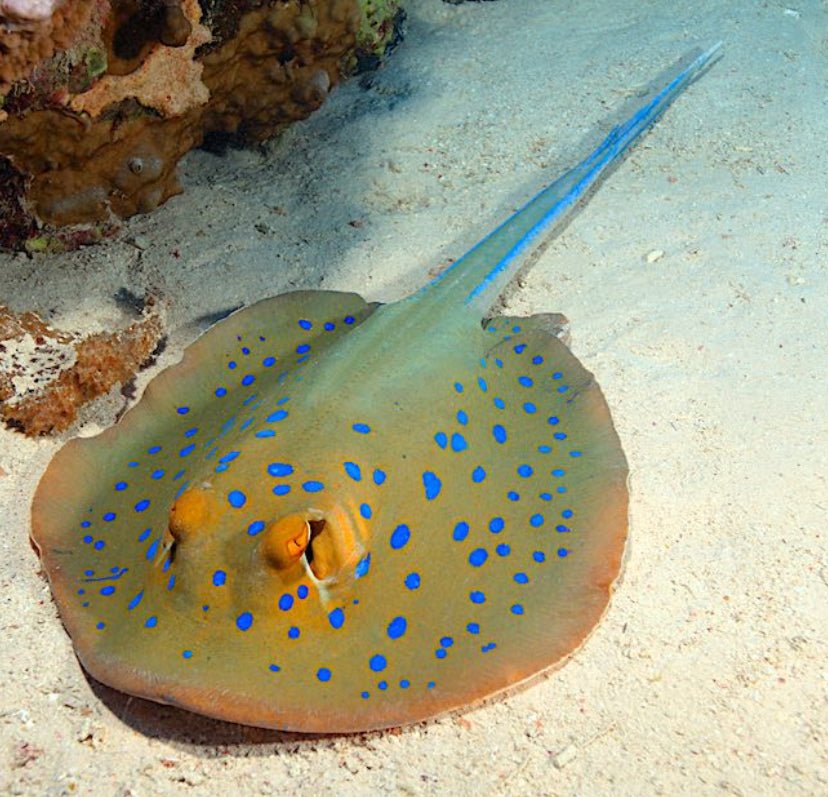
Blue Spotted Stingray
Blue Spotted Stingray
**Blue Spotted Stingray: A Majestic Marvel for Your Reef Aquarium**
The Blue Spotted Stingray (Taeniura lymma) is a mesmerizing addition to any reef aquarium, celebrated for its exquisite blue spots and graceful, undulating movement. This enchanting creature promises to be a showstopper in your aquatic oasis, offering both beauty and intrigue for reef enthusiasts.
**Care Level & Requirements**
- **Care Level:** Advanced
- **Temperament:** Peaceful
- **Minimum Tank Size:** 180+ gallons
- **Water Parameters:**
- **Temperature:** 75-82°F
- **pH:** 8.1-8.4
- **Salinity:** 1.020-1.025
The Blue Spotted Stingray requires a spacious environment to thrive, making a large tank essential. A sandy substrate is recommended to allow for natural burying behavior, and ample open space should be provided for swimming. Maintaining stable water parameters is crucial, as this species is sensitive to fluctuations.
**Feeding & Diet**
This stingray is a carnivorous feeder, relishing a diet of fresh or frozen seafood such as shrimp, squid, and small fish. Regular feeding schedules should be established, providing meals 2-3 times a week to ensure optimal health and vitality.
**Compatibility & Tank Mates**
The Blue Spotted Stingray is generally peaceful and can coexist harmoniously with a variety of reef tank inhabitants. However, care should be taken to avoid housing with aggressive species that may harass or outcompete it for food. It is essential to ensure that tank mates are compatible and that the stingray is not exposed to sharp or rough coral structures that could cause injury.
**A Unique Experience**
For experienced aquarists looking to elevate their reef aquarium with a truly unique and captivating specimen, the Blue Spotted Stingray offers an unparalleled opportunity. Its striking appearance and gentle demeanor make it not just another addition, but a central feature of your underwater world. Dive into a new realm of aquatic fascination with the Blue Spotted Stingray, and let its beauty transform your reef into a masterpiece.
Feeding & Diet
Feeding & Diet
An opportunistic omnivore, the Seahorse will scavenge detritus, uneaten food, and algae — making it a natural cleanup crew member. Supplement with small meaty foods like mysis shrimp or pellets 2–3x per week if natural food sources are limited.
Care & Water Parameters
Care & Water Parameters
The Seahorse thrives in stable, well-maintained reef conditions. Target parameters: temperature 72–78°F, salinity 1.025–1.026 SG, pH 8.1–8.4, and alkalinity 8–12 dKH. A mature, established tank of at least 20 gallons is recommended.
Reef & Tank Compatibility
Reef & Tank Compatibility
Generally considered reef-safe. The Seahorse coexists well with most corals and peaceful fish. Use caution with very small invertebrates or slow-moving tankmates. Provide ample rockwork and hiding spots to reduce territorial behavior.
Size & Growth
Size & Growth
Seahorses are typically shipped at 0.5–1.5 inches. They are slow-growing and generally remain small, making them well-suited for nano and mid-size reef systems.
Shipping & Live Arrival Guarantee
Shipping & Live Arrival Guarantee
All livestock ships with heat or cold packs as needed and is packaged for safe transit. We stand behind a live arrival guarantee — if your animal arrives DOA, contact us within 2 hours of delivery with a clear photo. See our full DOA policy for claim details.
Share