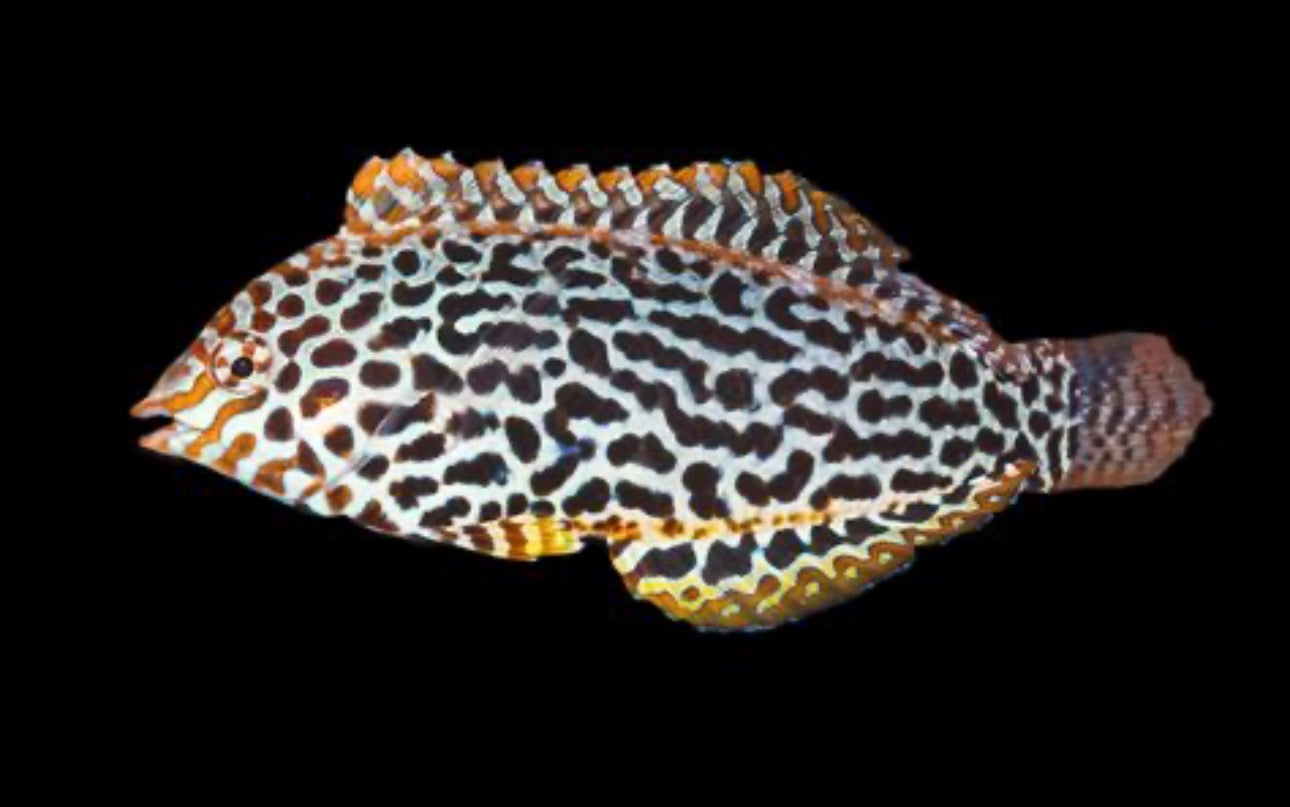
Leopard Wrasse
Leopard Wrasse
**Leopard Wrasse: The Vibrant Jewel of Your Reef Aquarium**
The Leopard Wrasse (Macropharyngodon meleagris) is a must-have for dedicated reef aquarium enthusiasts. With its dazzling array of colors—featuring a kaleidoscope of blues, greens, and yellows—this fish is more than just a visual delight. It is an active and engaging inhabitant that brings both beauty and balance to your underwater world.
**Care Requirements**
To ensure the well-being of your Leopard Wrasse, it is crucial to maintain optimal water conditions. Ideally, keep the temperature between 72-78°F, a pH of 8.1-8.4, and a salinity of 1.020-1.025. A tank size of at least 50 gallons is recommended, providing ample space for swimming and hiding. The Leopard Wrasse thrives in a well-established aquarium with plenty of live rock for grazing and exploration.
**Feeding**
Leopard Wrasses are carnivorous and have a diverse diet. They enjoy a mix of frozen mysis shrimp, brine shrimp, and finely chopped seafood. Supplement their diet with high-quality marine pellets or flakes to ensure they receive all necessary nutrients. Feeding them small amounts multiple times a day helps mimic their natural feeding habits.
**Reef Compatibility**
One of the standout features of the Leopard Wrasse is its compatibility with reef tanks. Gentle and peaceful, they are perfect companions for a variety of marine species. The Leopard Wrasse will not harm coral or other invertebrates, making it an ideal choice for a harmonious tank community.
**Why Choose Leopard Wrasse?**
By choosing the Leopard Wrasse, you are not only adding a spectacularly colored fish to your aquarium but also a diligent pest controller. Known for their appetite for small invertebrates, they help manage unwanted pests like flatworms and pyramidellid snails, contributing to a healthier environment for your reef inhabitants.
Introduce the Leopard Wrasse to your aquarium and watch as it brings life and vibrance to every corner of your aquatic sanctuary!
Feeding & Diet
Feeding & Diet
An opportunistic omnivore, the Seahorse will scavenge detritus, uneaten food, and algae — making it a natural cleanup crew member. Supplement with small meaty foods like mysis shrimp or pellets 2–3x per week if natural food sources are limited.
Care & Water Parameters
Care & Water Parameters
The Seahorse thrives in stable, well-maintained reef conditions. Target parameters: temperature 72–78°F, salinity 1.025–1.026 SG, pH 8.1–8.4, and alkalinity 8–12 dKH. A mature, established tank of at least 20 gallons is recommended.
Reef & Tank Compatibility
Reef & Tank Compatibility
Generally considered reef-safe. The Seahorse coexists well with most corals and peaceful fish. Use caution with very small invertebrates or slow-moving tankmates. Provide ample rockwork and hiding spots to reduce territorial behavior.
Size & Growth
Size & Growth
Seahorses are typically shipped at 0.5–1.5 inches. They are slow-growing and generally remain small, making them well-suited for nano and mid-size reef systems.
Shipping & Live Arrival Guarantee
Shipping & Live Arrival Guarantee
All livestock ships with heat or cold packs as needed and is packaged for safe transit. We stand behind a live arrival guarantee — if your animal arrives DOA, contact us within 2 hours of delivery with a clear photo. See our full DOA policy for claim details.
Share