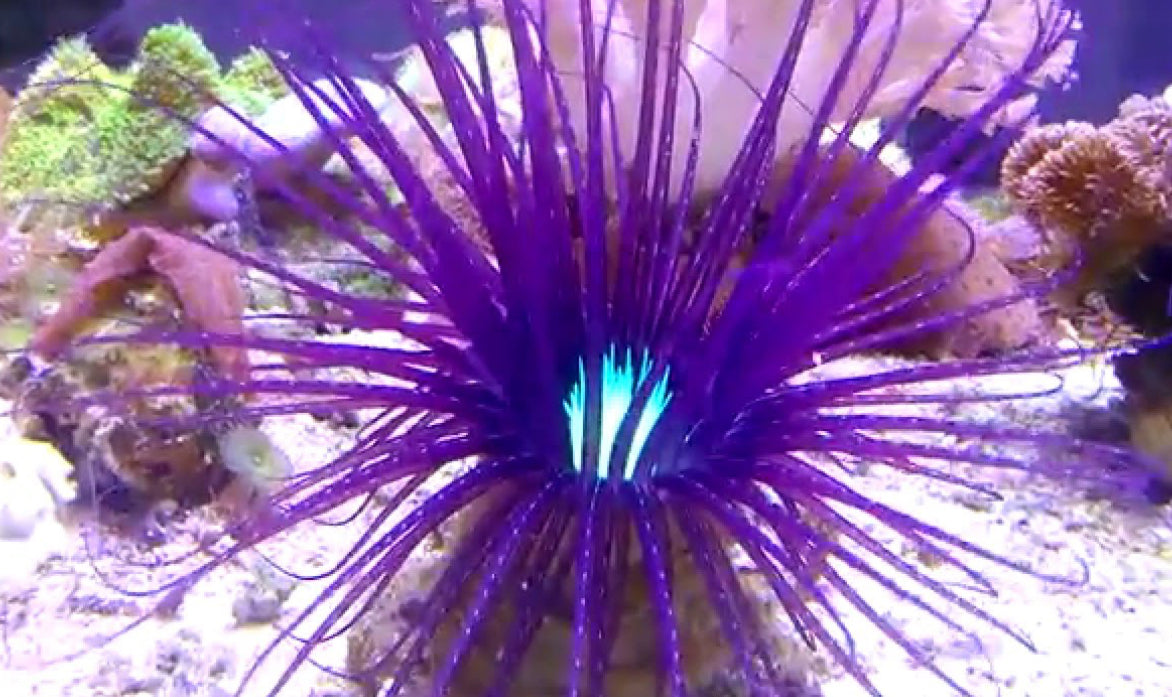
Tube Purple Anemone
Tube Purple Anemone
The Purple Tube Anemone (Cerianthus sp.) is a mesmerizing and unique invertebrate that adds dramatic movement and vibrant color to any reef aquarium. With its long, flowing purple tentacles that extend from a protective tube buried in the substrate, this anemone creates a stunning focal point.
Care Level & Requirements
Care Level: Moderate
Temperament: Semi-aggressive (stinging tentacles)
Minimum Tank Size: 30+ gallons
Diet: Carnivore - filter feeder and active hunter
Reef Safe: With caution - has potent sting
What to Expect
The Purple Tube Anemone is a fascinating creature that constructs a protective tube in the sand or substrate, from which it extends its beautiful purple tentacles to capture food. Unlike true anemones, tube anemones are actually cerianthids and have two distinct sets of tentacles - shorter oral tentacles around the mouth and longer marginal tentacles that can extend several inches.
Behavior & Compatibility
Important: Tube anemones possess a powerful sting and should be placed away from corals and other sessile invertebrates. They are not clownfish hosts and will sting fish that come into contact with their tentacles. Best kept in species-specific setups or with careful placement in mixed reefs.
Placement & Substrate Requirements
Tube anemones require a deep sand bed (4-6 inches minimum) or fine substrate where they can burrow and construct their protective tube. Once established, they should not be moved, as relocating can damage their delicate tube and stress the animal. Provide moderate water flow to deliver food particles while allowing tentacles to extend fully.
Feeding
Feed 2-3 times per week with meaty foods such as mysis shrimp, brine shrimp, chopped seafood, or specialized anemone foods. Target feed by placing food directly onto the tentacles or near the oral disc. They are active feeders and will capture food with their tentacles and bring it to their mouth.
Lighting Requirements
Tube anemones do not contain zooxanthellae and do not require intense lighting. Moderate to low lighting is preferred, making them ideal for lower-light reef systems or areas with subdued illumination.
Tank Considerations
Maintain stable water parameters with good water quality. Keep away from powerhead intakes and overflow areas where tentacles could be damaged. Provide adequate space (6-8 inches) from corals and other stinging invertebrates. They are sensitive to copper-based medications.
Acclimation
Use a slow drip acclimation method over 60-90 minutes. Handle with extreme care and never expose to air. Place gently on the substrate and allow the anemone to burrow naturally - this process may take several hours to complete.
Our Live Arrival Guarantee
Every Purple Tube Anemone ships with our live arrival guarantee, carefully packed to ensure it arrives healthy and ready to establish itself in your reef system.
Feeding & Diet
Feeding & Diet
An opportunistic omnivore, the Seahorse will scavenge detritus, uneaten food, and algae — making it a natural cleanup crew member. Supplement with small meaty foods like mysis shrimp or pellets 2–3x per week if natural food sources are limited.
Care & Water Parameters
Care & Water Parameters
The Seahorse thrives in stable, well-maintained reef conditions. Target parameters: temperature 72–78°F, salinity 1.025–1.026 SG, pH 8.1–8.4, and alkalinity 8–12 dKH. A mature, established tank of at least 20 gallons is recommended.
Reef & Tank Compatibility
Reef & Tank Compatibility
Generally considered reef-safe. The Seahorse coexists well with most corals and peaceful fish. Use caution with very small invertebrates or slow-moving tankmates. Provide ample rockwork and hiding spots to reduce territorial behavior.
Size & Growth
Size & Growth
Seahorses are typically shipped at 0.5–1.5 inches. They are slow-growing and generally remain small, making them well-suited for nano and mid-size reef systems.
Shipping & Live Arrival Guarantee
Shipping & Live Arrival Guarantee
All livestock ships with heat or cold packs as needed and is packaged for safe transit. We stand behind a live arrival guarantee — if your animal arrives DOA, contact us within 2 hours of delivery with a clear photo. See our full DOA policy for claim details.
Share